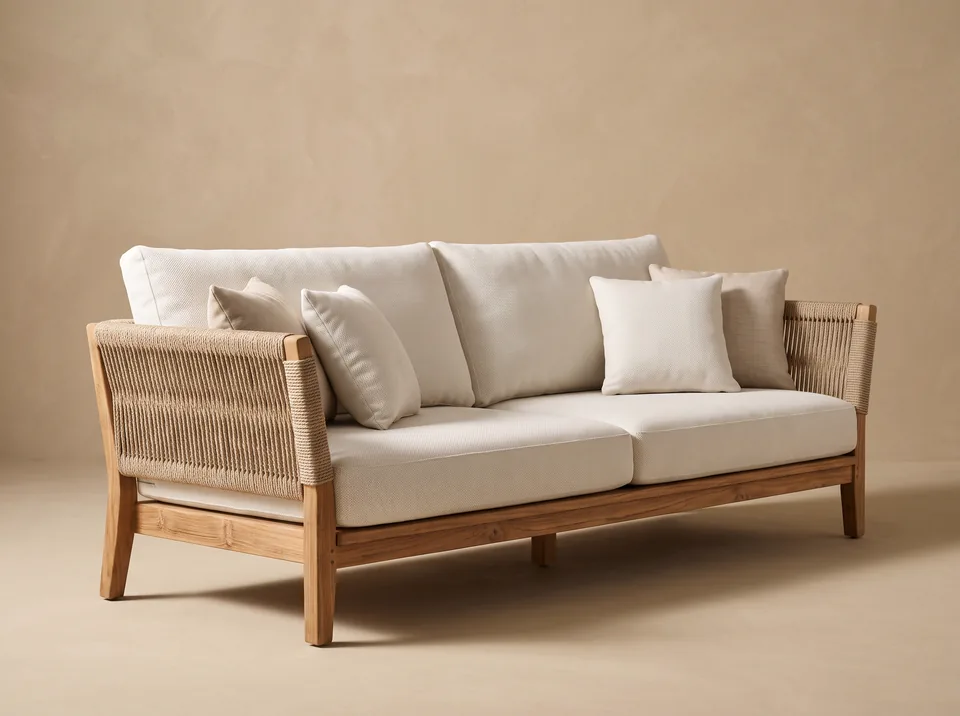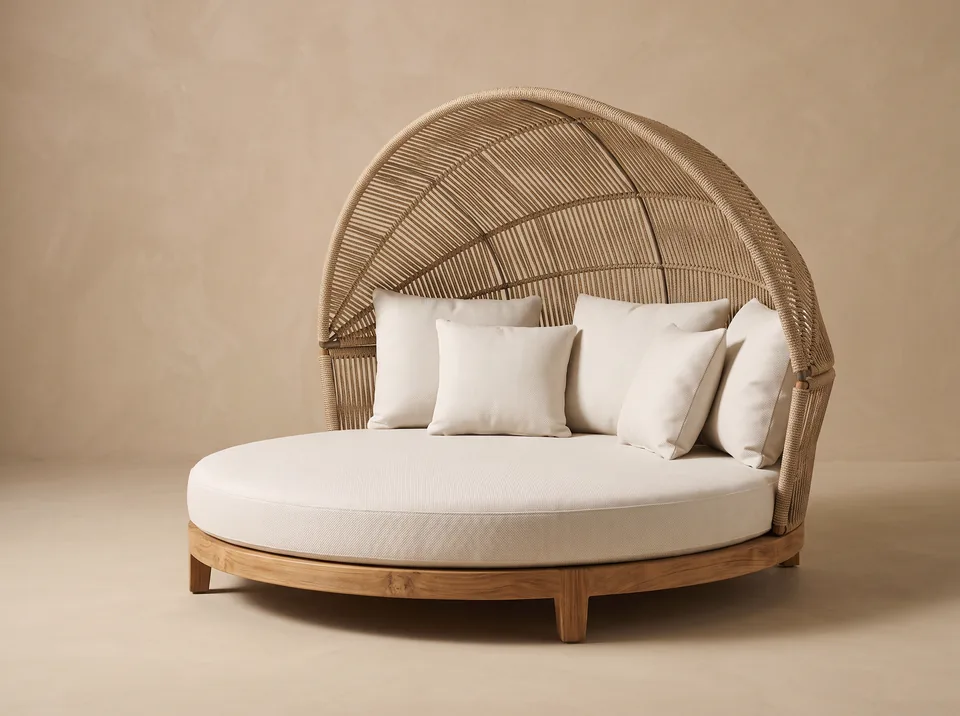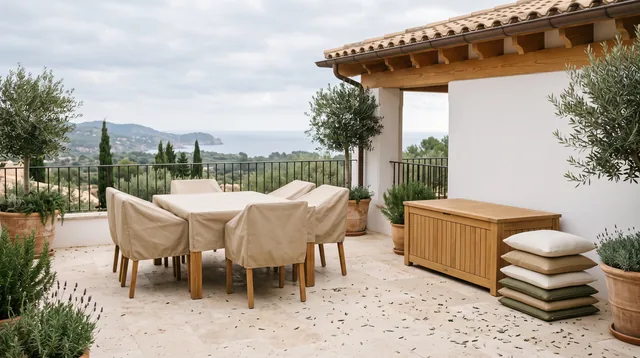
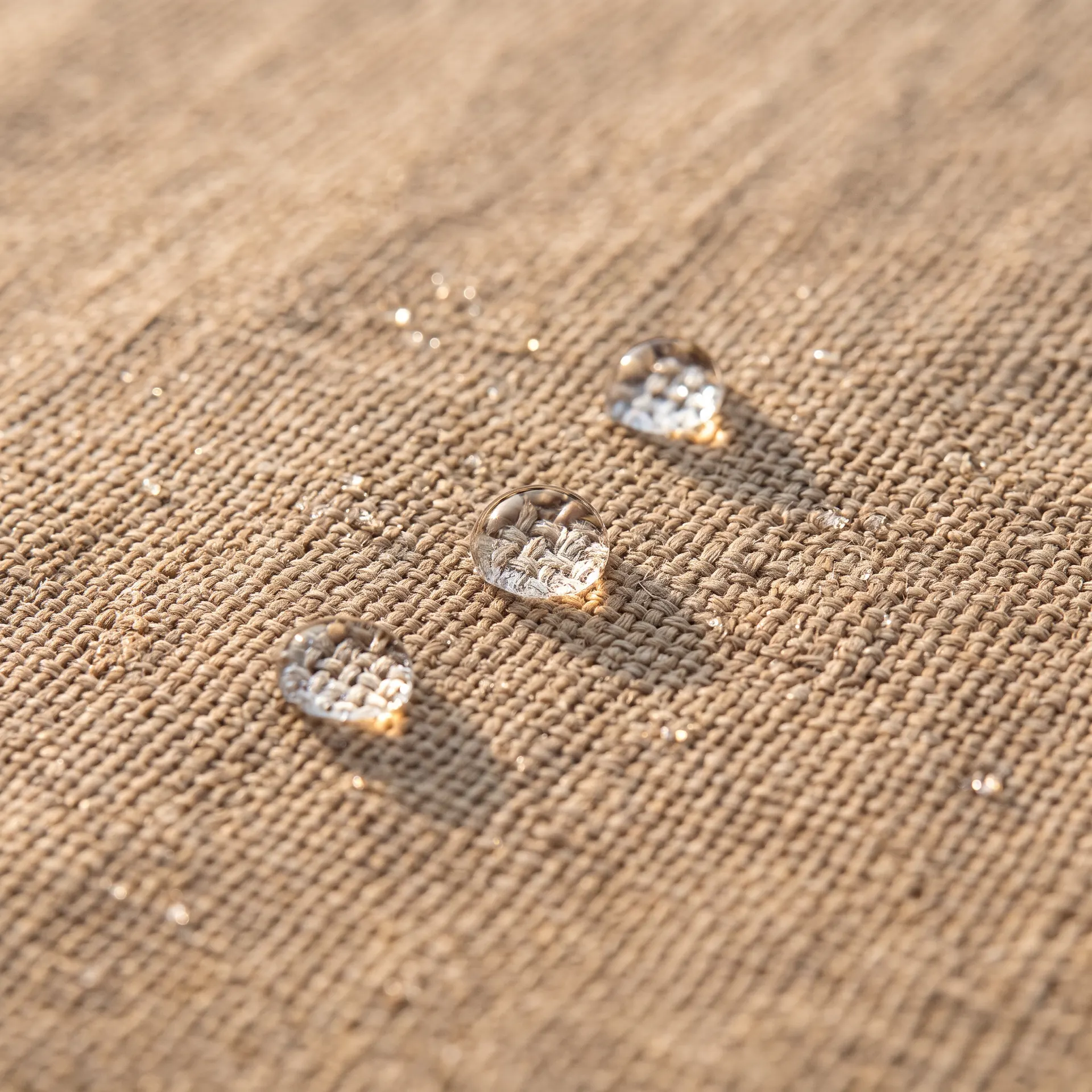
An outdoor cushion goes through more in one summer than a living-room sofa does in years: weeks of midday sun, rain showers, salty air, sun cream, pollen. Whether a fabric survives all this unscathed is decided in three places: the fibre, the dyeing method and the construction of the cushion as a whole. Once you understand these three points, you can read data sheets and put manufacturers' promises into perspective.
Three fibres, three characters
With high-quality outdoor covers, you will mainly encounter three synthetic fibres. They differ less in appearance than in how they behave over the years.
Acrylic
Solution-dyed acrylic is regarded as the benchmark for colour retention outdoors. The fibre is highly UV-resistant, feels soft and textile-like, and remains breathable. It is usually also given a water-repellent and dirt-repellent finish. Acrylic is comparatively expensive and can pill slightly under heavy abrasion.
Olefin
Olefin is made from polypropylene. The fibre absorbs practically no water, dries quickly, is light and resists many kinds of stain. With UV stabilisers it has good light resistance, but over many years it usually holds its colour slightly less well than acrylic. Olefin cannot tolerate high heat: irons, embers and hot barbecue grills are off limits.
Polyester
Polyester is tear-resistant, holds its shape and is inexpensive. Many polyester fabrics are only dyed or printed once they have been woven, and then fade more quickly in the sun. Solution-dyed polyester with UV stabilisation sits between basic polyester and acrylic in terms of light resistance.
| Fibre | Colour retention in the sun | Feel | Behaviour when wet | Points to note |
|---|---|---|---|---|
| Acrylic, solution-dyed | very high | soft, textile-like | water-repellent finish, breathable | higher price, slight pilling possible |
| Olefin | high | smooth to textile-like | absorbs hardly any water, dries quickly | sensitive to heat |
| Polyester, piece-dyed | medium to low | smooth | often coated | fades more quickly |
| Polyester, solution-dyed | medium to high | smooth to textile-like | often coated | quality varies greatly by manufacturer |
Besides these three fibres, you will often come across Textilene outdoors, a fabric woven from PVC-coated polyester yarns. It is used mainly for sun loungers and chair slings, is taut, dries very quickly and needs hardly any care. It does not replace the comfort of a cushion, which is why it is often combined with a thin pad.
Solution-dyed: why the dyeing method matters
In solution dyeing, the colour pigments are added to the liquid spinning solution before the fibre is forced through the spinneret. As a result, the colour runs through the entire cross-section of the fibre. With piece-dyed goods, by contrast, the finished fabric is dyed, so the colour sits mainly on the outside and is more directly exposed to UV radiation and cleaning.
In practice, this means that solution-dyed fabrics keep their colour even after many months in the sun and can usually withstand more thorough cleaning. Even so, the care instructions of the respective manufacturer remain the deciding factor.
Reading the figures: lightfastness, Martindale, hydrostatic head
Lightfastness
How well a dye stands up to light is tested to ISO 105-B02 and stated on the blue wool scale from 1 to 8. Level 8 represents the highest resistance. For indoor upholstery, a rating of 5 or above is already considered very good. For high-quality outdoor acrylic fabrics, manufacturers often quote ratings of 7 to 8.
Martindale abrasion resistance
The Martindale test to EN ISO 12947 rubs the fabric under a defined pressure until visible wear appears. The result is given in Martindale rubs. Manufacturers' guidelines classify the figures roughly as follows:
- up to 10,000: decorative use, such as scatter cushions
- 10,000 to 20,000: light domestic use
- 20,000 to 30,000: general use, such as sofas and dining chairs
- 30,000 to 50,000: heavy daily use
- over 50,000: contract use, such as hotels and restaurants
With outdoor fabrics, a high Martindale rating is welcome but rarely the first criterion. A cover that has faded after two summers never gets the chance to wear through: it is replaced long before that.
Pilling and hydrostatic head
The tendency to form small bobbles of fibre is rated on a scale from 1 (severe pilling) to 5 (no pilling). The hydrostatic head to EN ISO 811 states, in millimetres, the water pressure a fabric can withstand. It is mainly relevant for protective covers and parasols. Upholstery fabrics, on the other hand, are usually deliberately made only water-repellent, so that they breathe and dry quickly.
Other details on the data sheet
- Weight: The figure in grams per square metre tells you something about the density of the fabric, but not automatically about its quality. A light, tightly woven fabric can be more robust than a heavy, loosely woven one.
- Mould: Synthetic fibres themselves offer mould hardly any nourishment, but dirt, pollen and sun cream on the surface certainly do. Regular cleaning is therefore the most effective protection.
- Testing for harmful substances: Labels such as OEKO-TEX Standard 100 certify that a textile has been tested for substances harmful to health. They say nothing about weather resistance.
The core counts: quick-dry foam and covers
Even the best fabric is of little use if the foam underneath soaks up water like a sponge. For outdoor use, quick-dry foam has proved its worth: an open-cell upholstery foam with a continuous pore structure through which rainwater simply drains. It is often wrapped in polyester wadding, which gives a softer outline.
- Underside: A permeable mesh fabric on the bottom of the cover lets water drain away faster.
- Zip: Removable covers make cleaning and drying easier.
- Seams: UV-resistant sewing thread prevents seams from perishing after a few years while the fabric still looks good.
Care through the season
- Brush regularly: remove dust and pollen with a soft brush before moisture makes them stick.
- Treat stains immediately: dab (do not rub) with lukewarm water and pH-neutral soap, then rinse thoroughly with clean water.
- Typical problem substances: remove sun cream, bird droppings and tree resin as quickly as possible, as they will otherwise leave marks.
- Air-dry: do not put covers in the tumble dryer, and do not iron olefin.
- Renew the water repellency: when water no longer beads off, a suitable reproofing product can restore the protective effect.
Near the coast or a pool, it is worth rinsing covers with clean water from time to time. Salt crystals and chlorine residues lodge in the fibres, attract moisture and can take their toll on seams and finishes over time.
How to store cushions safely over winter is explained in our guide to winter care for garden furniture. You will find a comparison of acrylic, linen and bouclé in the Materials overview.