
A sofa is the piece of furniture on which you probably spend more hours than on any other apart from your bed. Yet it is often chosen from a photo or after a few seconds in a showroom, even though the most important criteria can be measured and compared: dimensions, the construction of the upholstery and the properties of the cover. The following values are guidelines from practice, not a standard. Your body and your habits have the final say.
The dimensions that determine comfort
| Dimension | Typical values | What matters |
|---|---|---|
| Seat height | usually 40 to 48 cm | Higher makes it easier to get up, lower looks more relaxed and lounge-like. |
| Seat depth | about 50 to 60 cm for sitting upright, considerably more for lounge sofas | Too deep means cushions behind your back, too shallow soon feels like a waiting area. |
| Back height | low back, mid back or high back | High backs support the head and neck, low ones keep the room open. |
| Armrests | narrow to wide, straight or rounded | Wide armrests take up seat width, but invite you to lean on them and put things down. |
Seat depth is the most common reason for a bad buy. A simple test: sit upright with your back against the backrest. There should be roughly two to three fingers' width of space between the back of your knees and the front edge of the seat, and your feet should rest flat on the floor. If you like to sit with your legs tucked up or to lie on the sofa, choose a deeper seat and add back cushions if needed.
Also check how the seat height behaves once you sink in. A soft cushion with a nominal height of 45 centimetres can feel considerably lower than a firm one at 42 centimetres.
Space, proportion and walkways
A sofa that looked dainty in the showroom can dominate the room at home. So plan in three steps:
- Proportion: as a design rule of thumb, a sofa takes up no more than about two thirds of the wall it stands against. The coffee table, in turn, looks right when it measures around two thirds of the length of the sofa.
- Distance to the table: about 40 to 50 centimetres between sofa and coffee table has proved its worth, enough room for your legs and close enough to put down a glass.
- Walkways: main routes should be around 80 to 90 centimetres wide, secondary routes at least about 60 centimetres. Behind a free-standing sofa, around 80 centimetres is comfortable.
The shape: two-seater, corner sofa, modular sofa
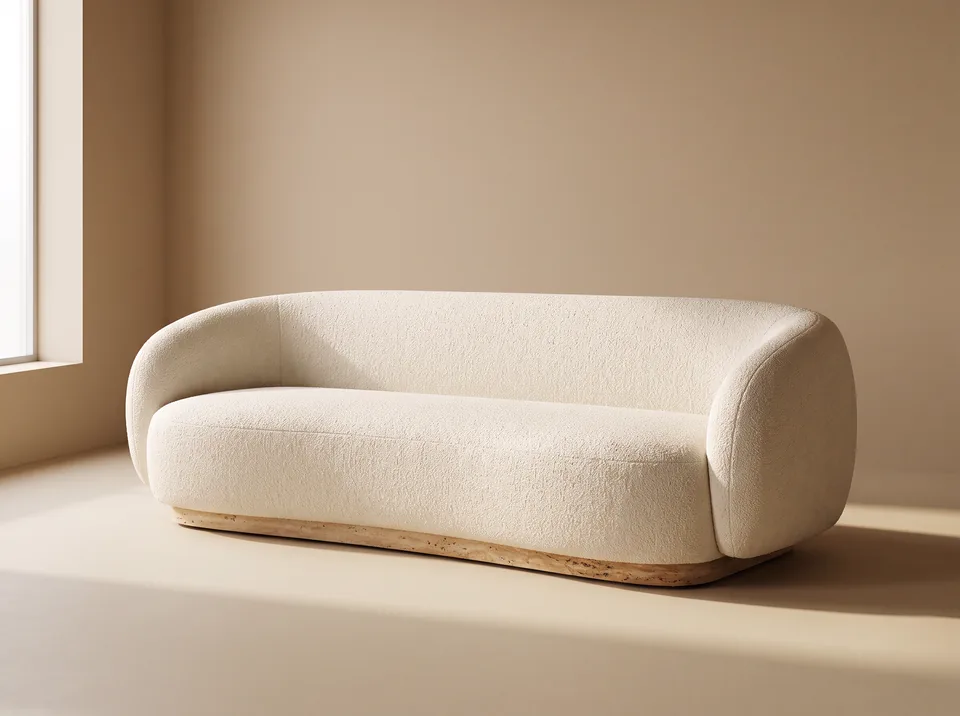
A classic sofa with two or three seats is easy to complement with armchairs to form a conversation group. A corner sofa offers plenty of seating on a small footprint, but fixes the layout of the room. A modular sofa made up of individual elements can grow with you when you move house or rearrange a room. In open-plan layouts, a sofa standing freely in the room often looks more generous than one against the wall; in that case the back should be carefully designed too.
With the Room Planner you can place the sofa, table and armchairs to scale in your floor plan and check the distances.
What lies inside: cold-cure foam, spring core, down
How a sofa feels, and how it looks after years of use, is decided beneath the cover. Manufacturers usually combine several layers.
Cold-cure foam
Highly elastic polyurethane foam adapts to the body and quickly returns to its shape. Two values describe it: density (RG), measured in kilograms per cubic metre, indicates how compact and durable the foam is, while compression hardness indicates how firm it is. A high density therefore does not automatically mean a hard cushion. For heavily used seats, many upholsterers regard a density of about 40 or more as a solid basis.
Spring core
With Bonnell springs, the steel springs are linked to one another and the cushion gives across its whole surface. With pocket springs, each spring sits in its own fabric pocket and responds precisely where the pressure is. Spring cores are usually covered with layers of foam and wadding, and give a lively, well-ventilated seating feel.
Down and feathers
Down or feather blends, often as a wrap around a foam core, give sofas that soft, slightly rumpled look. The price is upkeep: cushions need plumping up regularly, and dips in the seat are part of the character.
Frame and suspension
Beneath the upholstery, a frame carries the load, usually made of solid wood, plywood or metal. On top of it lies the suspension, for example tensioned webbing or serpentine springs bent into a sinuous wave. You never see this layer, but it helps to decide whether a sofa still supports you evenly after years or starts to sag. Ask about it specifically at a specialist retailer.
| Construction | Seating feel | Shape retention | Care |
|---|---|---|---|
| Cold-cure foam | even, soft to firm depending on compression hardness | high | low |
| Spring core with foam topper | springy, well ventilated | high | low |
| Foam core with down wrap | soft, sinking | medium | plump up regularly |
The cover: bouclé, linen, velvet, leather
For everyday use, a sofa cover should offer solid abrasion resistance. Manufacturers' guidelines cite about 20,000 to 30,000 Martindale rubs for sofas in general domestic use. If the sofa stands in the sun, also look for good lightfastness; on the blue wool scale, values of 5 and above are considered very good.
- Bouclé: looped yarn with a nubbly, soft surface, very cosy. Pets' claws can pull out loops.
- Linen: cool, matt, naturally creased. Pure linen can shrink in the wash; blended fabrics hold their shape better.
- Velvet: a deep play of colour and a soft pile. Shiny pressure marks, known as pile crush, are part of the material and not a defect.
- Leather: aniline leather is open-pored, particularly natural and develops a patina, but stains easily. Semi-aniline offers light protection, and pigmented leather is the easiest to care for.
Test-sitting the systematic way
- Take at least ten minutes and sit the way you do at home: upright, leaning back, sideways, lying down.
- Test it with two people. Does the seat give way when someone sits down next to you?
- Ask about the frame and suspension: solid wood or plywood and sturdy suspension point to a long life.
- Check seams, piping and corners. Good workmanship shows in the details.
- Ask for fabric samples to take home and look at them in daylight and in the evening light.
The overview of Materials shows which upholstery fabrics go with wood and stone. The sofa concepts in our Ideas section give you a feel for the shapes.