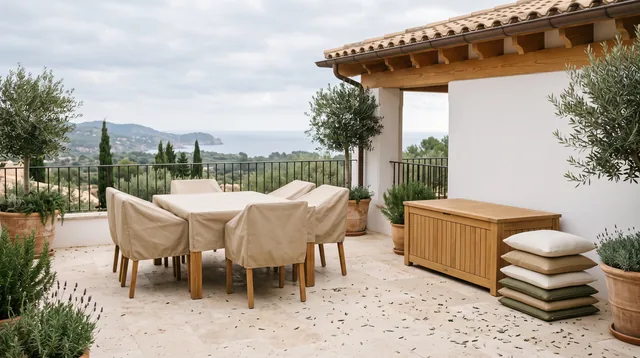

By day, the sun shapes your outdoor space; in the evening, you take over. Good outdoor lighting is rarely the brightest. It traces paths, lets an olive tree step out of the darkness, turns the dining table into the centrepiece and leaves the rest to the night. All this takes a suitable colour temperature, the right level of brightness, planning in layers and lights that can stand up to the weather.
Colour temperature: why 2200 to 3000 kelvin
Colour temperature is given in kelvin (K). The lower the value, the warmer the light appears. The German lighting industry initiative licht.de distinguishes between warm white (below 3300 K), neutral white (3300 to 5300 K) and daylight white (above 5300 K), and recommends warm white light for the garden.
| Colour temperature | Effect | Suitable for |
|---|---|---|
| around 1800 to 2200 K | amber, candle-like | table lamps, lanterns, insect-friendly accents |
| around 2700 K | warm white, homely | terrace, dining area, wall lights, transition to the living room |
| around 3000 K | warm white, slightly crisper | paths, entrances, plant lighting |
| from about 4000 K | neutral to cool | rarely suitable in a residential garden |
Besides colour temperature, pay attention to colour rendering. The colour rendering index Ra (CRI in English) shows how naturally colours appear; the maximum value is 100. Values of 80 and above are common, and from 90 upwards skin, wood and plants look particularly vivid.
Lumens, lux and the right amount of light
Two units are often confused. The lumen (lm) describes luminous flux, in other words the total amount of light a luminaire emits. The lux (lx) describes illuminance, in other words how much light actually reaches a surface; one lux equals one lumen per square metre. A luminaire with a high lumen output can therefore light a surface brightly or barely at all, depending on how wide its beam is and how far away it is.
Outdoors, the rule is almost always: less than you think. Your eyes adapt at dusk, and just a few well-placed points of light are enough for orientation. Contrast is what matters. Lights that are too bright make the surroundings look even blacker and cause glare.
- Use several soft light sources rather than one powerful floodlight.
- Choose shielded luminaires so that you never look directly into the light source.
- Check the effect after dark before you fix the lights in place for good.
Planning in layers
Professional lighting design thinks in layers that can be switched separately. That way, the same terrace can be set for a dinner, a quiet moment by the fire or the late walk back into the house.
- Orientation: paths, steps and transitions. On stairs, light from above helps, because each step then casts a short shadow and is easy to make out. Bollard lights and lights recessed into walls provide glare-free light at knee height.
- Function: light where something is being done: at the dining table, at the barbecue, at the front door. Pendant lights above the dining table, or lamps standing on it, create an island of light without illuminating the surroundings.
- Accent: highlighting individual features. A spotlight uplighting an olive tree, or a light grazing a travertine wall, gives the garden depth.
- Atmosphere: fire pit, lanterns, battery-powered table lamps. This layer is mobile and can be warm and subdued.
IP ratings explained
The IP code under DIN EN 60529 describes how well a device is protected against the ingress of foreign objects and water. The first digit stands for foreign objects and dust (0 to 6), the second for water (0 to 9). For outdoor luminaires, licht.de cites IP44 as the minimum requirement.
| IP rating | Foreign objects | Water | Typical use |
|---|---|---|---|
| IP44 | protection against objects larger than 1 mm | splashing water from all directions | covered areas, wall lights under a canopy |
| IP65 | dust-tight | water jets from all directions | free-standing luminaires fully exposed to the weather |
| IP67 | dust-tight | temporary immersion | in-ground lights, spots where water may collect |
| IP68 | dust-tight | continuous immersion as specified by the manufacturer | pool, pond, water features |
The IP rating should not be confused with the protection class, which describes protection against electric shock, for example by means of a protective earth conductor or double insulation. Low-voltage systems running at 12 or 24 volts and supplied via a power supply unit are also popular in gardens.
Insect-friendly and considerate
Artificial light attracts nocturnal insects, especially light with a high proportion of blue and UV. Many municipalities and nature conservation bodies therefore recommend warm white light of no more than 3000 K, ideally 2700 K or less. Amber LEDs of around 2200 K and below are considered particularly wildlife-friendly. But colour is not the only thing that counts:
- Direct it downwards: shielded luminaires that do not shine into the sky reduce stray light.
- Limit the hours: timers and motion sensors ensure that lights are only on when they are needed.
- Use accents sparingly: light trees with a narrow beam angle, keep them dimmed and switch them off late at night.
- Think of the neighbours: no light across the property boundary or into other people's windows.
Legislators are addressing the issue too. In Germany, the Federal Nature Conservation Act has contained a provision since 2021 on protecting animals and plants from the adverse effects of lighting (§ 41a). In the Balearic Islands, a dedicated law protecting the night from light pollution has been in force since 2005.
Dimming, control, solar or mains
Dimmability matters almost more outdoors than indoors. A light that is pleasant over dinner is often too bright late at night. Check that the luminaire, the lamp and the dimmer are compatible with one another, or opt for a wirelessly controlled system that lets you save lighting scenes.
| Solution | Strengths | Limitations |
|---|---|---|
| Hard-wired (230 V) | full output, reliable, permanent | installation by a qualified contractor, early planning |
| Low voltage (12/24 V) | easy to extend, low voltage in the garden | power supply and cable lengths need planning |
| Solar | no cables, quick to position | output and running time depend on the weather, batteries age |
| Rechargeable lights | portable, ideal for the table and lounge area | regular charging |
Solar lights work well as markers and for small accents; for paths, stairs and dining areas, permanently installed lighting is usually the more reliable solution. How light can support the transition between living room and terrace is explained in our article Connecting indoors and outdoors. Design concepts for outdoor furniture and lighting await you among our Ideas.